
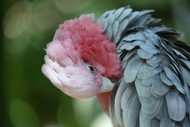
Galah Fact Sheet
Posted by Galah Facts, what to feed a Galah, Galah diets, Galah Parrots on 3/4/2025
Rosemary Low explains more about Galahs in this Galah Fact Sheet.

The Galah (Eolophus roseicapillus), also known as the Roseate or Pink?breasted Cockatoo, is a widespread Australian species recognised for its striking pink and grey plumage, moderate size (34cm) and long lifespan of around 50 years. Generally more independent and less affectionate than white Cockatoos, Galahs can make amusing companions but are highly prone to obesity if not given a correct low?fat diet and plenty of daily flight.
They are naturally destructive, loud, and require regular fresh branches for chewing, making them more suitable for experienced owners willing to meet their demanding care needs. Common in the wild and easily sexed by iris colour (though DNA sexing is most reliable), they thrive on varied seeds, grains, greens, and vegetables, and benefit from a vet?checked purchase due to the species? susceptibility to health issues when poorly managed.
Scientific name
Eolophus roseicapillus
Common names
Roseate Cockatoo, Pink-breasted Cockatoo
Adult length
34cm (13? in): males usually larger
Adult weight
300g to 400g
Potential lifespan
50 years

For everything you need for Galahs please click here.
Status in wild
Common
Origin
Australia ? almost the whole continent, including Tasmania
Sexing
The iris of the eye is dark brown to black in most males and dark red or reddish-brown in most females. However, this is not an invariable rule, so DNA sexing is the safest method.
Temperament
Usually less nervous, less excitable, more independent and less affectionate than the white Cockatoos. However, some Galahs do make amusing and affectionate pets.
The fact that they are more independent could be related to the breeding biology: young spend only seven weeks in the nest (14 weeks in the Moluccan Cockatoo) and compete with up to five siblings (in the wild probably only a single Moluccan would fledge).
In the wild young Galahs start to feed on their own within a month of fledging and are independent after six or seven weeks.
(Moluccan Cockatoos probably spend nearly one year with their parents.)
Suitability as a Companion Bird
Not recommended unless the purchaser is prepared to take some trouble with the diet and allows the Cockatoo to be full-winged with daily flying exercise in the house.
The reason for this is that Galahs are extremely susceptible to obesity, usually caused by incorrect diet and lack of exercise. This results in the growth of fatty tumours, usually on the abdomen.

A vet friend in Australia told me about a Galah which weighed 504g (18oz). It was so fat it had to be euthanased. After removal of all subcutaneous fat it weighed 405g.
There were fatty infiltrations in some organs, especially the liver. In the UK I heard about a three-year old Galah which died, also due to incorrect diet.
Disadvantages: As is normal in Cockatoos, Galahs are very destructive and can cause much damage to furniture or wooden doors and window frames. They have a great need to gnaw and should have a twice weekly supply of branches cut from willow or apple trees.
They greatly enjoy branches from eucalyptus. It is recommended that Eucalyptus gunni is planted. This is readily available in garden centers in the UK and is extremely fast growing.
The loud, harsh voice is another disadvantage. This should be considered carefully before the bird is purchased. Galahs often learn to mimic a few words but ?talking? ability is limited.
Buying Advice
Some breeders give buyers a hatch certificate which tells you the date the bird was hatched and its ring number. All serious breeders ring their young but few, if any, breeders sell young with a health certificate.
A vet check might be considered by the purchaser, especially for the high-priced mutation Galahs, if the breeder agreed. However, a reputable breeder should agree to a test for PBFD, for example, but you would have to pay for it.
This involves pulling a few breast feathers or taking a very small amount of blood and is worth considering for all species of Cockatoos. A breeder would probably disregard the results of any tests made after the bird left his or her premises as they could say that the bird contracted the disease after it left. Of course, for you own peace of mind, you could still have tests carried out.
Diet
The basis of the diet should be a high quality Parakeet mixturelike this one with a good variety of seeds and very few or no sunflower seeds. An excess of items high in fats and oils will result in obesity, serious health problems and early death.
Galahs will also eat spray millet. Wild green foods are an important part of the diet and can include seeding grasses, dandelions (whole young plants), smooth sow thistle (whole young plants), seeding dock and, of course, chickweed. Celery, carrot, peas in the pod, corn on the cob, sweetcorn and green beans can also be offered, along with the usual fruits.
In the wild Galahs feed on small seeds for which they spend hours daily searching on the ground. In the wheat belt of Western Australia, cereal grains such as wheat, oats and barley, make up three-quarters of their diet for most of the year. These grains, preferably soaked or sprouted, are an excellent food for captive Galahs.

Did You Know??
Galahs have hybridised with white Cockatoos. Hybridising should be discouraged ? but in Australian aviaries where several species are kept together, hybrids have occurred.
Recommended Reading: Behavioural Ecology of the Galah by Ian Rowley (1990), ISBN 0 949324 27 2.
Cockatoos in Aviculture by Rosemary Low (1993), ISBN 1-903995-05-1
Sign up to get early access to exclusive deals, special offers, new arrivals, blogs and more...